
Buying a house is exciting, but one of the biggest questions first-time home buyers have is: How long does it take to buy a house?
While every home purchase is different, a straightforward transaction can often move from mortgage preapproval to closing in roughly four to six weeks after an offer is accepted. However, the timeline can be shorter or longer depending on the loan program, appraisal, inspection, underwriting, seller, title work, and how quickly documents are provided.
The good news is that understanding the home-buying timeline can make the process much less stressful. At InterWest Mortgage, we help borrowers understand what happens at each stage, what their lender needs, and how to keep the loan moving toward closing.
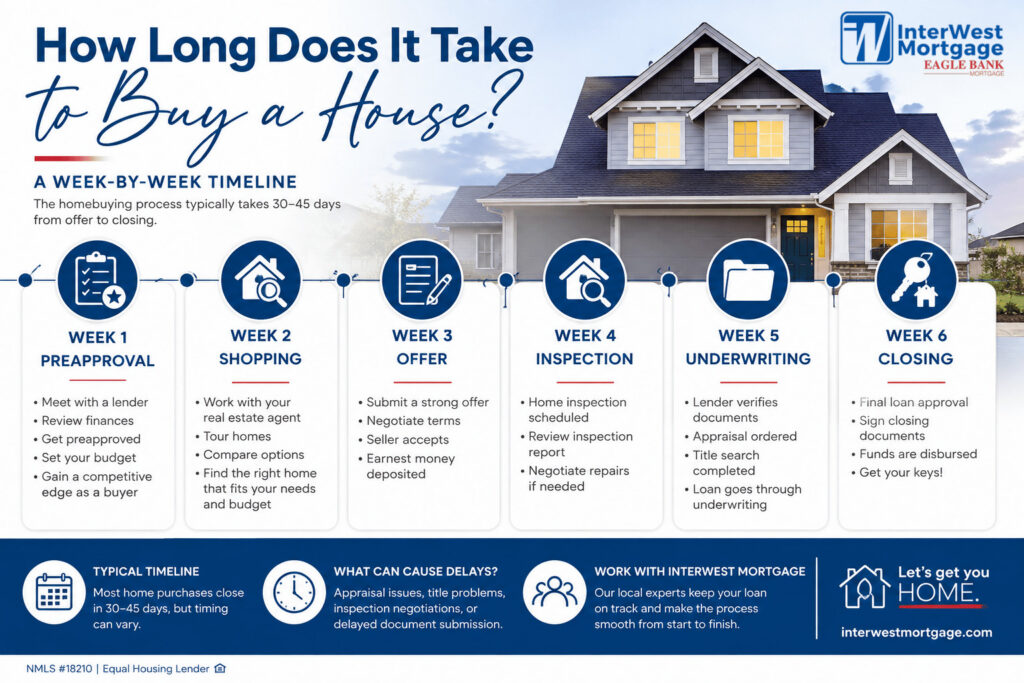
Here is a practical six-week home-buying timeline to help you understand what to expect.
Week 1: Get Preapproved for a Mortgage
Before you start seriously shopping for a home, one of the smartest things you can do is get preapproved for a mortgage.
A preapproval gives you a much clearer idea of how much you may be able to borrow and what your estimated payment could look like. It also gives sellers confidence that you are a serious buyer.
During the preapproval process, your lender will typically review information such as:
- Income and employment
- Credit history
- Existing debts
- Assets and savings
- Down payment funds
- Proposed loan amount
- Potential loan programs
The Consumer Financial Protection Bureau recommends that borrowers compare mortgage options and obtain preapprovals from multiple lenders to evaluate rates, terms, programs, and costs.
How InterWest Mortgage Helps
InterWest Mortgage can help you determine how long it takes to buy a house and which mortgage program makes sense for your situation, whether that involves a Conventional, FHA, VA, USDA Rural Development, Idaho Housing & Finance, or another qualifying program.
The goal isn’t simply to tell you how much you can borrow. It’s to help you understand how much home you can afford within your budget.
Week 2: Start Shopping for Your Home
Once you’re preapproved, you can begin shopping with a much better understanding of your potential price range.
This is where your real estate agent becomes an important part of the process.
You’ll be looking at:
- Home prices
- Neighborhoods
- Property taxes
- HOA fees (if applicable)
- Property condition
- Commute times
- School considerations
- Monthly payment estimates
Remember, your maximum loan approval isn’t necessarily your ideal home-buying budget.
A lender may approve you for a certain amount, but you still need to consider utilities, maintenance, insurance, taxes, savings, retirement contributions, and other household expenses.
Don’t Forget the Loan Program
The type of property you’re purchasing can also influence your financing options.
For example, a buyer may qualify for different programs depending on whether they are:
- A first-time home buyer
- A veteran or eligible service member
- Purchasing in a rural area
- Looking for a low-down-payment option
- Using an Idaho housing assistance program
InterWest Mortgage can help you compare these options before you make an offer.
Week 3: Make an Offer and Start the Mortgage Process
Once you find the right house, your real estate agent will help you submit an offer.
If the seller accepts, the mortgage process moves into a much more detailed phase.
Your lender may need additional documentation to verify your income, assets, employment, debts, and other financial information.
This is also when you’ll begin receiving and reviewing important mortgage documents.
A Loan Estimate provides important information about your proposed loan, including the loan amount, interest rate, estimated monthly payment, and estimated closing costs. Under federal rules, lenders generally provide the Loan Estimate within three business days after receiving the required application information.
Your Job During Week 3
One of the best ways to keep your mortgage moving is to be responsive.
If your lender requests:
- Bank statements
- Pay stubs
- Tax documents
- Employment verification
- Identification
- Explanations for deposits or transfers
Provide them as quickly and accurately as possible.
The CFPB specifically recommends responding promptly to lenders’ requests and notes that large deposits or transfers may require documentation showing the source of the funds.
Week 4: Home Inspection and Appraisal
Two different things are happening around this stage that buyers sometimes confuse:
The inspection protects the buyer.
The appraisal helps establish the property’s value for the mortgage.
Home Inspection
A home inspection is designed to identify potential problems with the property.
Depending on the inspection, you may discover issues involving:
- Roof
- HVAC
- Plumbing
- Electrical systems
- Foundation
- Appliances
- Windows
- Structural components
If significant problems are discovered, your real estate agent may help negotiate repairs or other changes to the purchase agreement.
The CFPB notes that inspection issues can sometimes affect the transaction and that certain loan programs may have property-condition requirements.
The Appraisal
An appraisal is different from a home inspection.
An appraisal provides an independent opinion of the property’s value. Your lender may use the appraisal to determine whether the property provides sufficient collateral for the mortgage.
What If the Appraisal Comes in Low?
A low appraisal can create a problem because the lender may be unwilling to lend the originally expected amount given the lower value.
Depending on the circumstances, possible solutions could include:
- Renegotiating the purchase price
- Increasing the buyer’s down payment
- Challenging the appraisal
- Exploring another financing structure
- Negotiating with the seller
This is one reason having an experienced mortgage professional involved is so important.
Week 5: Underwriting and Final Loan Approval
For many buyers, underwriting is the part of the mortgage process that feels mysterious.
Underwriting is essentially the lender’s detailed review of your financial information and the property to determine whether the loan meets applicable lending requirements.
The underwriter may review:
- Income
- Employment
- Credit
- Assets
- Debt
- Appraisal
- Property information
- Loan program requirements
- Documentation provided during the application
It’s normal for the lender to request additional information during this stage.
Why Is My Mortgage Taking So Long?
Underwriting can take longer when:
- Documents are missing
- Income is complicated
- A borrower is self-employed
- There are large bank deposits
- Credit issues need clarification
- Employment needs additional verification
- The appraisal raises questions
- Property documentation is incomplete
That doesn’t necessarily mean something is wrong with the loan.
Often, the lender simply needs additional documentation before issuing final approval.
How InterWest Mortgage Helps
InterWest Mortgage’s goal is to keep communication clear and move documentation through the process as efficiently as possible.
The faster you respond to requests, the faster your loan team can address outstanding conditions.
Week 6: Final Approval and Closing
Once underwriting conditions have been satisfied, the loan can move toward closing.
This is when everything comes together.
Before closing, you’ll receive a Closing Disclosure outlining the final terms of your mortgage and the costs associated with the transaction.
Federal rules generally require borrowers to receive the Closing Disclosure at least three business days before closing, giving them time to review the final terms.
You should carefully review:
- Loan amount
- Interest rate
- Monthly payment
- Closing costs
- Cash required to close
- Prepaid expenses
- Escrow amounts
- Seller credits
- Other transaction details
If something doesn’t look right, ask your lender or settlement agent before signing.
Closing Day
Finally, you’ll sign the documents required to complete the purchase and mortgage.
Once the transaction is completed and the applicable funds are disbursed and documents recorded, ownership transfers to you.
Then comes one of the best parts:
You get the keys to your new home.
Frequently Asked Questions About Buying a House
How long after appraisal does it take to close?
There isn’t one universal answer. If the appraisal is acceptable and the rest of the loan file is complete, the mortgage can continue into final underwriting and closing. If the appraisal creates questions about value or property condition, additional work may be required.
How long after underwriting does it take to close?
If underwriting has been completed and all conditions have been satisfied, the loan can proceed to final approval and closing. The exact timing depends on the lender, title company, closing agent, and whether any additional conditions remain.
Why is underwriting taking so long?
Underwriting may take longer when the lender needs additional documentation or clarification regarding income, employment, assets, debts, credit, the appraisal, or the property.
The best thing you can do is respond promptly to your loan officer’s requests and provide complete documentation.
How long does a mortgage preapproval take?
The timing varies depending on your financial situation and how quickly you provide the necessary information. A straightforward application with complete documentation can often move quickly.
How long does it take to close on a house after an offer is accepted?
Many buyers should expect approximately four to six weeks, although the timeline varies considerably depending on the transaction and loan program.
Can a mortgage close in less than 30 days?
Yes, some transactions can close in less than 30 days when the buyer, lender, seller, appraiser, title company, and other parties can move quickly. However, buyers shouldn’t assume every mortgage can meet that timeline.
What can delay closing on a house?
Common causes include:
- Delayed documentation
- Appraisal problems
- Inspection issues
- Title problems
- Employment changes
- Credit changes
- Large unexplained deposits
- Underwriting conditions
- Delays from other parties
That’s why communication is so important.
Start Your Home-Buying Journey With InterWest Mortgage
Buying a home doesn’t have to feel like a six-week mystery.
When you understand what happens during preapproval, home shopping, making an offer, inspection, appraisal, underwriting, and closing, you can approach the process with much greater confidence.
InterWest Mortgage helps borrowers throughout the mortgage process by providing knowledgeable guidance, responsive communication, and loan solutions tailored to their individual circumstances.
Whether you’re a first-time home buyer, veteran, move-up buyer, or someone purchasing a rural property, having an experienced mortgage team in your corner can make a significant difference.
If you’re wondering how long it will take to buy your next home, the best time to start is before you find the house. Talk with InterWest Mortgage about getting preapproved and creating a realistic roadmap from application to closing. Give us a call at 208-525-8778.
Mortgage timelines vary by borrower, loan program, property, lender, and other transaction-specific factors. This article is for educational purposes and is not a commitment to lend or a guarantee of a particular closing timeline.