
One of the first questions many home buyers ask is:
“Which home loan has the lowest interest rate?”
It’s an excellent question—but in real terms the answer isn’t always straightforward.
This may sound like loan jargon, but the answer is that the lowest interest rate isn’t necessarily the best mortgage for every borrower. Different loan programs are designed for different financial situations, and interest rates vary based on factors such as loan risk, government guarantees, down payment requirements, credit score, and market conditions.
At InterWest Mortgage, our experienced loan officers help first-time buyers compare their options, understand how mortgage rates are determined, and help choose the loan that provides the greatest long-term value—not just the lowest advertised rate.
What Determines Your Mortgage Interest Rate?
Before comparing loan programs, it’s helpful to understand what influences mortgage rates.
Lenders consider several factors, including:
- Credit score
- Down payment amount
- Loan amount
- Debt-to-income (DTI) ratio
- Employment and income history
- Property type
- Loan term (15-year vs. 30-year)
- Current financial markets
- Government backing or loan guarantees
Because every borrower is unique, two people applying for the same loan program may receive different interest rates.
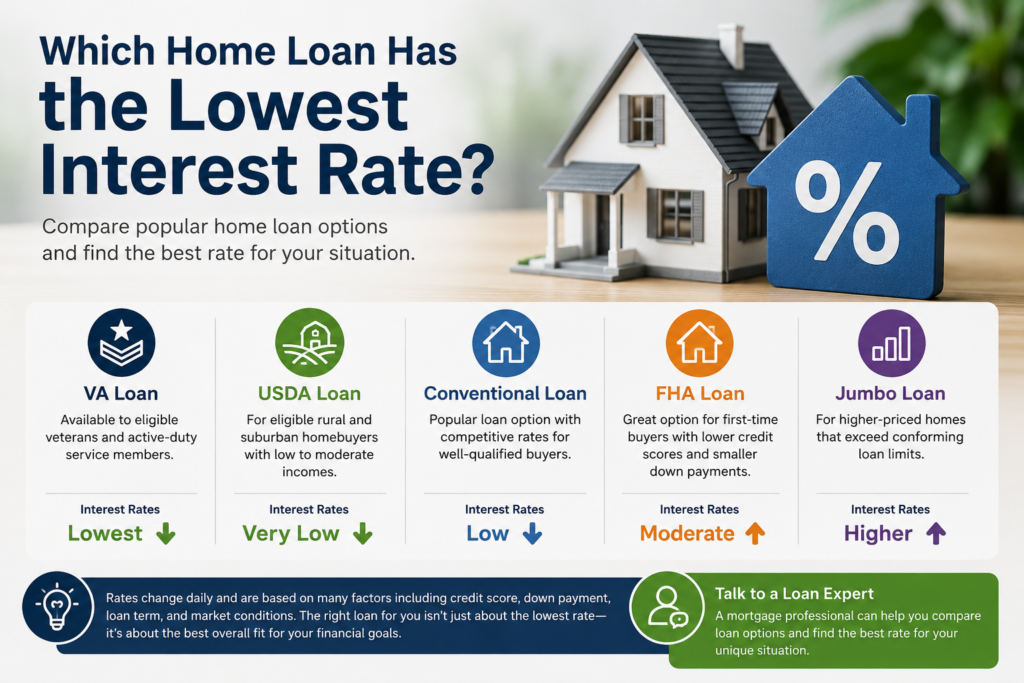
Home Loans Ranked from Lowest to Highest Typical Interest Rates
While rates change daily, government-backed and lower-risk loans often receive more favorable pricing than higher-risk financing options.
1. VA Loans – Often Among the Lowest Mortgage Rates Available
For eligible veterans, active-duty military personnel, and certain surviving spouses, VA loans often offer some of the lowest interest rates available.
Why Are VA Rates So Low?
The U.S. Department of Veterans Affairs guarantees a portion of the loan, reducing the lender’s financial risk.
Benefits often include:
- Competitive interest rates
- No down payment for qualified borrowers
- No monthly mortgage insurance (PMI)
- Flexible credit requirements
For many eligible borrowers, a VA loan provides the lowest overall cost of homeownership.
2. USDA Rural Development Loans
USDA loans also tend to offer very competitive interest rates.
These loans are backed by the U.S. Department of Agriculture and are designed to encourage homeownership in eligible rural and suburban communities.
Benefits include:
- Zero down payment for qualified buyers
- Competitive fixed interest rates
- Affordable mortgage insurance costs
Many first-time buyers are surprised to learn they qualify for USDA financing even if they don’t consider themselves “rural.” Make sure to ask about this type of loan.
3. FHA Loans
FHA loans remain one of the most popular options for first-time home buyers.
These loans are insured by the Federal Housing Administration, allowing lenders to offer financing to borrowers with more flexible credit and down payment requirements.
Why FHA Rates Are Often Lower
Because FHA loans are government-insured, lenders assume less risk.
Benefits include:
- Lower down payment requirements
- Flexible credit guidelines
- Competitive fixed rates
However, borrowers should also consider FHA mortgage insurance premiums, which may increase the total monthly payment.
4. Conventional Loans
Conventional loans are not backed by the federal government.
Instead, they generally follow guidelines established by Fannie Mae and Freddie Mac.
Interest rates on conventional loans can be extremely competitive—especially for borrowers with:
- Excellent credit
- Larger down payments
- Lower debt-to-income ratios
For highly qualified borrowers, conventional financing may provide one of the best long-term values because private mortgage insurance can often be removed once sufficient home equity is established.
5. Jumbo Loans
Jumbo loans exceed the conforming loan limits established by Fannie Mae and Freddie Mac.
Because lenders assume greater financial risk, jumbo loan rates may be slightly higher or, depending on market conditions, occasionally similar to conventional rates.
Borrowers generally need:
- Strong credit
- Significant assets
- Stable income
- Larger cash reserves
6. Non-QM (Non-Qualified Mortgage) Loans
Non-QM loans are designed for borrowers who don’t fit traditional lending guidelines.
These may include:
- Self-employed borrowers
- Investors
- Business owners
- Individuals with non-traditional income
Because these loans involve greater lending risk, they often carry higher interest rates than conventional or government-backed financing.
Remember: The Lowest Interest Rate Isn’t Always the Lowest Cost
Many buyers focus exclusively on the interest rate.
However, experienced mortgage professionals encourage borrowers to evaluate:
- Closing costs
- Discount points
- Lender fees
- Mortgage insurance
- Total monthly payment
- Long-term borrowing costs
Sometimes a slightly higher interest rate paired with lower fees can result in greater overall savings.
InterWest Mortgage helps buyers compare the complete financial picture—not just the headline rate — in a simple illustrated outline based on the following information.
What Documents Do You Need to Apply for a Home Loan?
Preparing your documentation early can help speed up the approval process.
Most lenders request:
Proof of Income
Examples include:
- Recent pay stubs
- W-2 forms
- Tax returns
- Social Security or pension documentation (if applicable)
Self-employed borrowers may also need:
- Business tax returns
- Profit and loss statements
- Business bank statements
Employment Verification
Lenders typically verify:
- Current employment
- Length of employment
- Income stability
Bank Statements
Borrowers generally provide recent bank statements showing:
- Down payment funds
- Closing cost funds
- Cash reserves
Identification
Examples include:
- Driver’s license
- State-issued ID
- Passport
Credit Information
Lenders obtain a credit report to review:
- Credit score
- Payment history
- Existing debts
- Outstanding obligations
Asset Documentation
Depending on the loan, borrowers may also provide documentation for:
- Retirement accounts
- Investment accounts
- Gift funds
- Other financial assets
How InterWest Mortgage Makes the Process Easier
Buying your first home shouldn’t be confusing, and unfortunately it often is. This is because many lenders advertise lower rates than are possible, simply to get you to reach out to them.
InterWest Mortgage helps simplify every step with zero fluff.
Fast Pre-Approvals
Many buyers receive quick pre-approval decisions after submitting their documentation.
This allows buyers to begin shopping with confidence.
No Unnecessary Upfront Lender Fees
Unlike some lenders that require upfront credit card payments or processing fees, InterWest Mortgage focuses on helping qualified buyers begin the mortgage process without unnecessary upfront lender costs.
Expert Guidance
InterWest’s experienced loan officers explain:
- Which loan fits your goals
- Current mortgage rate options
- Credit improvement opportunities
- Down payment assistance programs
- Monthly payment comparisons
Instead of guessing, buyers receive personalized recommendations based on their financial situation.
Competitive Rates Across Multiple Loan Programs
InterWest Mortgage offers financing solutions including:
- Conventional loans
- FHA loans
- VA loans
- USDA Rural Development loans
- State and local homebuyer assistance programs
- Refinancing options
Having access to multiple loan programs allows buyers to compare options and choose the financing that best meets their needs.
Frequently Asked Questions
Which mortgage loan has the lowest interest rate?
VA loans and USDA Rural Development loans often offer some of the lowest interest rates, followed by FHA and conventional loans. The best option depends on your eligibility and financial profile.
Why are VA loan rates lower?
VA loans are backed by the U.S. Department of Veterans Affairs, reducing lender risk and allowing for highly competitive interest rates.
Is the lowest interest rate always the best mortgage?
Not necessarily. Closing costs, lender fees, mortgage insurance, and long-term borrowing costs should also be considered.
What credit score do I need to qualify?
Credit score requirements vary by loan program. FHA loans generally allow lower credit scores than many conventional loans, while stronger credit often results in better interest rates.
How long does mortgage pre-approval take?
Pre-approval timelines vary based on documentation, but many buyers receive a decision quickly after providing the necessary financial information.
What documents are needed for mortgage approval?
Most lenders require proof of income, tax returns, employment verification, bank statements, identification, and authorization to review your credit history.
Does InterWest Mortgage charge upfront lender fees?
InterWest Mortgage focuses on making homeownership more accessible by helping qualified buyers begin the loan process without unnecessary upfront lender fees.
Can InterWest Mortgage help first-time buyers?
Absolutely. InterWest Mortgage specializes in helping first-time home buyers understand their financing options, navigate the mortgage process, and choose the loan program that best fits their goals.
Why More First-Time Buyers Choose InterWest Mortgage
Purchasing your first home is one of life’s biggest financial decisions, and choosing the right lender is just as important as choosing the right home.
InterWest Mortgage combines competitive interest rates, transparent communication, fast pre-approvals, and personalized service to make the mortgage process as smooth and stress-free as possible. Whether you’re comparing FHA, VA, USDA, or conventional loans, our experienced loan officers will help you understand your options, answer your questions, and guide you from application to closing.
If you’re wondering which home loan offers the lowest interest rate—or simply want expert advice on the best mortgage for your unique situation—InterWest Mortgage is here to help. With access to a wide range of loan programs, no unnecessary upfront lender fees, and a commitment to exceptional customer service, we’re ready to help you take the first step toward homeownership with confidence.